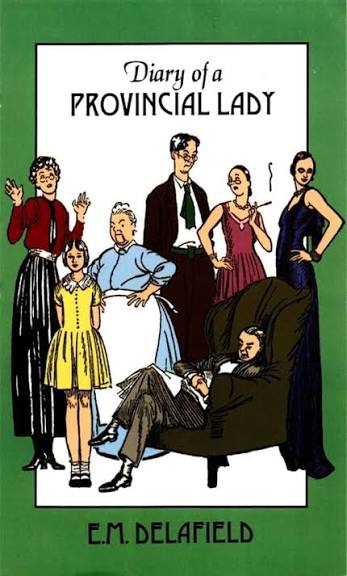
On Tuesday, October 13, at 2 pm we will meet virtually to discuss Diary of a Provincial Lady by E.M. Delafield. The meeting is on the second Tuesday of the month, as usual.
Questions and comments are welcome. Address them to tonilin@aol.com.
The link and info on attending the meeting will be sent to you upon RSVP to tonilin@aol.com.
The books to be discussed in October and beyond are described below.
October 2026 — Diary of a Provincial Lady, E. M. Delafield (1930, 171 p) A British woman chronicles the absurdities of domestic life in diary form. Upper-middle-class woman living in rural Devon. The book became a beloved classic of interwar British literature for its wit and realism. – JG — Witty, observant, and irresistibly sharp, Diary of a Provincial Lady invites readers into the quietly chaotic life of an upper-middle-class woman in 1930s England.
November 2026 — Arrow, William Gadea. (2025, 219 p) In ARROW, William Gadea weaves together insights from neuroscience, evolutionary studies, the Buddhist tradition, history, imagination, and memoir – to tell the story of Story. How many different faculties, each with their own independent adaptive utility – consciousness, self, emotions, episodic memory, mental modeling, theory of mind, language – converged to create the majestic power of storytelling.
Includes a discussion with the author at our meeting.
December 2026 –The Innocents Abroad by Mark Twain (1869, 432 p) The Innocents Abroad, published in 1869, is Mark Twain’s humorous travelogue about a five-month “Great Pleasure Excursion” to Europe and the Holy Land in 1867, chronicling his journey on the steamship Quaker City. The book satirizes American tourists’ reverence for European landmarks, contrasting it with Twain’s own no-nonsense, often irreverent perspective, and became his best-selling work during his lifetime. It’s a blend of travel guide, comedy, and social commentary, critiquing both American and European cultures.
January 2027 — God Bless You, Mr. Rosewater, Kurt Vonnegut (2007, 290 p) Eliot Rosewater—drunk, volunteer fireman, and President of the fabulously rich Rosewater Foundation—is about to attempt a noble experiment with human nature . . . with a little help from writer Kilgore Trout. God Bless You, Mr. Rosewater is Kurt Vonnegut’s funniest satire, an etched-in-acid portrayal of the greed, hypocrisy, and follies of the flesh we are all heir to.
February 2027 — Death at La Fenice by Donna Leon (2004, p 288) Book 1 of 33
A conductor succumbs to cyanide at the famed Venice opera house, in the first mystery in the New York Times–bestselling, award-winning series.
During intermission at the famed La Fenice opera house in Venice, Italy, a notoriously difficult and widely disliked German conductor is poisoned—and suspects abound. Guido Brunetti, a native Venetian, sets out to unravel the mystery behind the high-profile murder. To do so, he calls on his knowledge of Venice, its culture, and its dirty politics. Along the way, he finds the crime may have roots going back decades—and that revenge, corruption, and even Italian cuisine may play a role.
“One of the most exquisite and subtle detective series ever.” —The Washington Post
March 2027 — Anxious People by Fredrik Backman (2020, 349 p) Amazon Best Book of the Year for 2020.
From the #1 New York Times bestselling author of A Man Called Ove and “writer of astonishing depth” (The Washington Times) comes a poignant comedy about a crime that never took place, a would-be bank robber who disappears into thin air, and eight extremely anxious strangers who find they have more in common than they ever imagined.